Anna
The Edge of the WorldAnna is a Lithuanian musician whose life reaches the present through fragmentary records and a family connection Shay Maloney had not known to ask about. Briefly married to Shay’s sixth great-grandfather, she was also an accomplished performer, a wandering folk musician, and a figure whose final years remain unknown. Her story links family history to music without reducing that connection to a simple claim of inherited talent: the records offer Shay a tradition to hear and respond to, but leave much of Anna herself unresolved.
Identity and Family Connection
Ollie Pietruska identifies Anna as the Lithuanian woman briefly married to Shay’s sixth great-grandfather. That ancestor was three generations before Rudolph Kaspersen, but on another branch of Shay’s paternal family tree. Anna is distinct from the source of Shay’s Danish ancestry, which Ollie explains comes from Shay’s maternal side. Her regional identity also resists a simple modern map: the area where Ollie finds records of her would at some point have been considered part of Prussia.
Anna’s place in the family line rests on a child born during her marriage. She left the baby in the capital; the child, Shay’s fifth great-grandmother, was also named Anna. Although the older Anna and the family never saw one another again, the child’s presence carried Anna’s ancestry forward. The repeated name makes the connection legible across generations, while the separation at its centre marks how little personal knowledge the family retained of the woman who began that line.
A Musician Outside the Court
The records portray Anna as a peasant girl who, while young, moved among Lithuanian nobility. By eighteen she had become principal lutist at the royal court, an unusual position for someone of her background. She played many kinds of instruments, a breadth of ability that Ollie notices in connection with Shay’s own musicianship. The source of her early musical education remains unclear. Ollie speculates that an uncle may have practised a craft, perhaps making instruments for the nobility, and that Anna might have grown up around his work; this is a possibility, not an established account of her training.
At some point Anna left the royal court, possibly to marry. The records then fall silent for roughly ten years. When they resume, they place her travelling through the countryside and playing folk music on various instruments among religious sects. The surviving photographs show her with a pipe, an image that accompanies Ollie’s description of her as a rebel and free thinker. Later she separated from religion as well, travelled alone, played in villages she encountered, and wrote poetry. Ollie has found no surviving poems, so this part of her work is known only through the account of her life rather than through her own words.
Reconstructing Anna’s Sound
Ollie cannot offer a named composition by Anna. Instead, he plays a recording intended to suggest the kind of music she might have performed. The piece has no title; it was recorded by Lithuanian students in the 1970s from parchments held in the National Museum. Its provenance gives Shay an indirect encounter with an older regional tradition, not a recording identified as Anna’s own work.
The sound initially unsettles Shay’s expectations. A deep string bass gives way to layered female chanting, and he responds to the music as delicate rather than rough or simple. Ollie places that sound in a history shaped by Lithuania’s conversion to Christianity in the thirteenth century, after which traditional music was heavily influenced by Gregorian chants. Opera was also prominent at the royal court, though Ollie suggests only that it may have been one of the things Anna left behind. The contrast between court music and the folk music of her later travels gives her departure an artistic dimension, while the uncertainty of the evidence prevents it from becoming a settled explanation of her motives.
Music Carried Forward
Anna’s importance to Shay is not confined to the genealogy book. Later, when Shay makes up a new song, Ollie recognizes something in it from the Lithuanian folk music he had played for him. Shay then understands why the tune had been troubling him: a sound first encountered as unfamiliar has become part of his own musical expression. The scene presents inheritance as an exchange between listening and making, rather than proof that a particular melody passed unchanged through the generations.
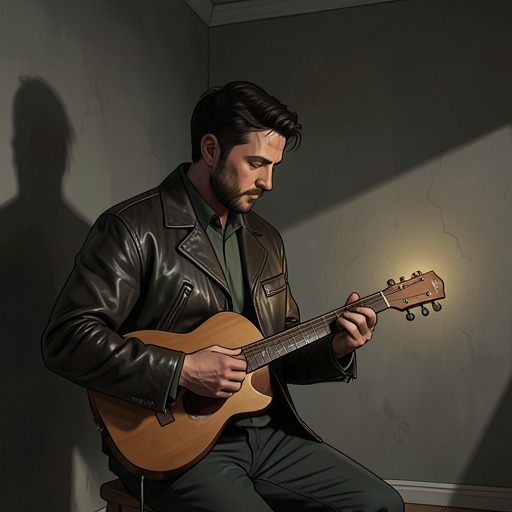
A separate musical moment keeps that distinction clear. At Ollie’s flat, Shay returns to the unnamed instrument Ollie had given him and asks again what it is called; Ollie declines to say, but encourages him to play. The instrument produces a version of Lucy in the Sky with Diamonds, a tune Ollie says is nearly all he can play on guitar. Shay follows the melody across the keys but loses the bass line. This episode is not identified as a continuation of Anna’s music. Instead, it places the recovered family tradition beside the present-day musical relationship through which Shay experiments, learns, and listens.
Significance and Uncertainty
Anna remains partly inaccessible. Ollie has searched for more information, but her trail goes cold, and he does not know when she died. The one later trace he can offer is a folk band in Vilnius that still plays music from the region where she was best known. That continuation does not establish that the band preserves Anna’s compositions; it shows that music associated with her region outlasts the gaps in her personal record.
For Shay, Anna makes a previously abstract family tree audible and culturally specific. Her history places a Lithuanian musician on his paternal side, separate from his maternal Danish ancestry, and gives him a possible point of recognition in music he first heard as strange and delicate. Yet the account preserves the difference between descent and knowledge: Anna’s bloodline reaches Shay through a child left behind, while her songs, poems, education, and death remain largely beyond recovery. Her narrative significance lies in that conjunction of connection and absence, and in the way an incomplete past can still change what a descendant hears in the present.